Throughout my time at university I had the opportunity to study a variety of books as we had a lot of very different modules available to us. There were many that I loved, many that I just about tolerated and some that I forced myself to finish (as I did try to read as many of the novels as possible) or just gave up with.
So, I thought I’d go through my five favourite books that I studied at university! As always, this list isn’t in any particular order.
I studied this dystopian novel in my Health, Illness and Technological Imaginaries module (like I said, our modules were different) and loved it. My entire dissertation was around dystopian novels so they’re usually a win for me. I just loved how this was pretty much the reverse of Kazuo Ishiguro’s Never Let Me Go. It’s also one of the only dystopian novels that I’ve read where I felt genuinely unsettled as it felt like the idea of this society could actually come to fruition in reality.
I’ve briefly mentioned this book before, but this was a novel I also studied in my Health, Illness and Technological Imaginaries module. Unfortunately, I missed our discussion seminar on this novel (as I was failing my driving test at the time) which is a shame as I had so much I wanted to say about the novel. I thought this was a really interesting take on the idea of a small number of humans left alive and it remains one of my favourite sci-fi novels. Perhaps I will re-read this one to review it properly, as well as give the rest of the series a shot!
Now, I’m going to be honest, I’m not a fan of Jane Austen at all. I’ve read four of her books at this point and this is the only one that I have enjoyed (sorry to all the fans of Mr. Darcy out there). This novel came up in my Gothic to Goth module which looked at the progression from Gothic literature to the ‘Goth’ subculture. What Austen does with this novel is very clever and it’s a brilliant parody of the classic ‘gothic’ genre and one I thoroughly enjoyed.
This novel was included in my Postcolonialism module and it was just amazing. When I used to see a long book on my reading list, I would feel a bit of dread as it could very well derail your reading for the entire week for other modules, but that dread was totally unfounded with this book. The novel is set in 1970s India which sees four different characters come together during India’s ‘State of Internal Emergency’. A Fine Balance is both hopeful and heartbreaking, and a novel I highly recommend.
I’m fairly certain this novel was in my first year module The History of Literature. I had heard of the book before but I didn’t really know anything about it. I think one of the reasons I enjoyed this novel so much is because it wasn’t what I expected at all, it also opened my eyes to post-modernism. I loved the sudden change in narration and it made the novel feel fresh and left a big impression.
Now, the reason this is a bonus entry is because it isn’t actually a book it’s actually a play that I studied in my Modernism module. I love it when texts break the fourth wall, so to speak, and this is something this play does brilliantly. With the characters storming the stage, demanding that their author finish their stories. I would love to be able to see this play performed in person.
Have you read any of these texts? Do you have favourite texts you’ve studied at school or uni? Tell me what they were! Also, let me know if you’re interested in a post going over the worst books that I studied at university.
The year is 1926, and Shanghai hums to the tune of debauchery.
A blood feud between two gangs runs the streets red, leaving the city helpless in the grip of chaos. At the heart of it all is eighteen-year-old Juliette Cai, a former flapper who has returned to assume her role as the proud heir of the Scarlet Gang—a network of criminals far above the law. Their only rivals in power are the White Flowers, who have fought the Scarlets for generations. And behind every move is their heir, Roma Montagov, Juliette’s first love…and first betrayal.
But when gangsters on both sides show signs of instability culminating in clawing their own throats out, the people start to whisper. Of a contagion, a madness. Of a monster in the shadows. As the deaths stack up, Juliette and Roma must set their guns—and grudges—aside and work together, for if they can’t stop this mayhem, then there will be no city left for either to rule.
Publisher: HarperVoyager UK Publication Date: 01/05/2018 Length: 531 pages Genre: Fantasy
CW: sexual assault, graphic violence
When Rin aced the Keju—the Empire-wide test to find the most talented youth to learn at the Academies—it was a shock to everyone: to the test officials, who couldn’t believe a war orphan from Rooster Province could pass without cheating; to Rin’s guardians, who believed they’d finally be able to marry her off and further their criminal enterprise; and to Rin herself, who realized she was finally free of the servitude and despair that had made up her daily existence. That she got into Sinegard—the most elite military school in Nikan—was even more surprising.
But surprises aren’t always good.
Because being a dark-skinned peasant girl from the south is not an easy thing at Sinegard. Targeted from the outset by rival classmates for her color, poverty, and gender, Rin discovers she possesses a lethal, unearthly power—an aptitude for the nearly-mythical art of shamanism. Exploring the depths of her gift with the help of a seemingly insane teacher and psychoactive substances, Rin learns that gods long thought dead are very much alive—and that mastering control over those powers could mean more than just surviving school.
For while the Nikara Empire is at peace, the Federation of Mugen still lurks across a narrow sea. The militarily advanced Federation occupied Nikan for decades after the First Poppy War, and only barely lost the continent in the Second. And while most of the people are complacent to go about their lives, a few are aware that a Third Poppy War is just a spark away . . .
Rin’s shamanic powers may be the only way to save her people. But as she finds out more about the god that has chosen her, the vengeful Phoenix, she fears that winning the war may cost her humanity . . . and that it may already be too late.
This month I went a little rogue and went over the budget I allow myself for books… But I just couldn’t resist! I think a lot of these books have an autumn feel to them, books that I can get all cozy with. After reading the most books I’ve ever read in a month in August, I was very excited to restock my shelves! Check out the GoodReads description for the books below.
I thought about being too small for so much, but that no one told you when you were big enough … and I asked God if he please couldn’t take my brother Matthies instead of my rabbit. ‘Amen.’
Jas lives with her devout farming family in the rural Netherlands. One winter’s day, her older brother joins an ice skating trip; resentful at being left alone, she makes a perverse plea to God; he never returns. As grief overwhelms the farm, Jas succumbs to a vortex of increasingly disturbing fantasies, watching her family disintegrate into a darkness that threatens to derail them all.
Aristotle is an angry teen with a brother in prison. Dante is a know-it-all who has an unusual way of looking at the world. When the two meet at the swimming pool, they seem to have nothing in common. But as the loners start spending time together, they discover that they share a special friendship–the kind that changes lives and lasts a lifetime. And it is through this friendship that Ari and Dante will learn the most important truths about themselves and the kind of people they want to be.
Jocasta is just fifteen when she is told that she must marry the King of Thebes, an old man she has never met. Her life has never been her own, and nor will it be, unless she outlives her strange, absent husband.
Ismene is the same age when she is attacked in the palace she calls home. Since the day of her parents’ tragic deaths a decade earlier, she has always longed to feel safe with the family she still has. But with a single act of violence, all that is about to change.
With the turn of these two events, a tragedy is set in motion. But not as you know it.
On Earth We’re Briefly Gorgeous is a letter from a son to a mother who cannot read. Written when the speaker, Little Dog, is in his late twenties, the letter unearths a family’s history that began before he was born — a history whose epicenter is rooted in Vietnam — and serves as a doorway into parts of his life his mother has never known, all of it leading to an unforgettable revelation. At once a witness to the fraught yet undeniable love between a single mother and her son, it is also a brutally honest exploration of race, class, and masculinity. Asking questions central to our American moment, immersed as we are in addiction, violence, and trauma, but undergirded by compassion and tenderness, On Earth We’re Briefly Gorgeous is as much about the power of telling one’s own story as it is about the obliterating silence of not being heard.
What would you change if you could go back in time?
In a small back alley in Tokyo, there is a café which has been serving carefully brewed coffee for more than one hundred years. But this coffee shop offers its customers a unique experience: the chance to travel back in time.
In Before the Coffee Gets Cold, we meet four visitors, each of whom is hoping to make use of the café’s time-travelling offer, in order to: confront the man who left them, receive a letter from their husband whose memory has been taken by early onset Alzheimer’s, to see their sister one last time, and to meet the daughter they never got the chance to know.
But the journey into the past does not come without risks: customers must sit in a particular seat, they cannot leave the café, and finally, they must return to the present before the coffee gets cold . . .
In the aftermath of the Third Poppy War, shaman and warrior Rin is on the run: haunted by the atrocity she committed to end the war, addicted to opium, and hiding from the murderous commands of her vengeful god, the fiery Phoenix. Her only reason for living is to get revenge on the traitorous Empress who sold out Nikan to their enemies.
With no other options, Rin joins forces with the powerful Dragon Warlord, who has a plan to conquer Nikan, unseat the Empress, and create a new Republic. Rin throws herself into his war. After all, making war is all she knows how to do.
Piranesi’s house is no ordinary building: its rooms are infinite, its corridors endless, its walls are lined with thousands upon thousands of statues, each one different from all the others. Within the labyrinth of halls an ocean is imprisoned; waves thunder up staircases, rooms are flooded in an instant. But Piranesi is not afraid; he understands the tides as he understands the pattern of the labyrinth itself. He lives to explore the house.
There is one other person in the house-a man called The Other, who visits Piranesi twice a week and asks for help with research into A Great and Secret Knowledge. But as Piranesi explores, evidence emerges of another person, and a terrible truth begins to unravel, revealing a world beyond the one Piranesi has always known.
Have you read any of the books I got this month? Are any on your wishlist? Let me know!
Before you can don your graduation gown and leave with an expensive piece of paper certifying that you have graduated in English Literature, you have one final hurdle… The dissertation. Now, as anticlimactic as this may be, I actually enjoyed doing my dissertation. It was stressful at times, but overall I loved doing the research and working on my own project. I even managed to submit my dissertation five days early too.
As my Top Five Friday was all about how to survive your Literature degree, I thought I would share how I approached my dissertation to help any final year Literature students who may be worried about the year ahead. This is a bit of a long one, so grab a coffee or a tea and get cozy!
Creating a concept
Personally, I found this the most difficult part of the entire process. I had so many bits of ideas but nothing concrete to write about for 10,000 words. I spoke to my personal tutor and she said that for a dissertation proposal you just need to be general in terms of time period and texts so they know who to assign as your dissertation advisor.
Once I was assigned my dissertation advisor, it was much easier to come up with an idea talking through my proposal and interests with someone who could guide me. I ultimately came up with the title of The Impact of Gender, Setting and Time on Psychological Survival in Dystopian Societies. Since then I’ve thought of more ideas that I could have done which would probably be more interesting, but that’s the best I could do at the time.
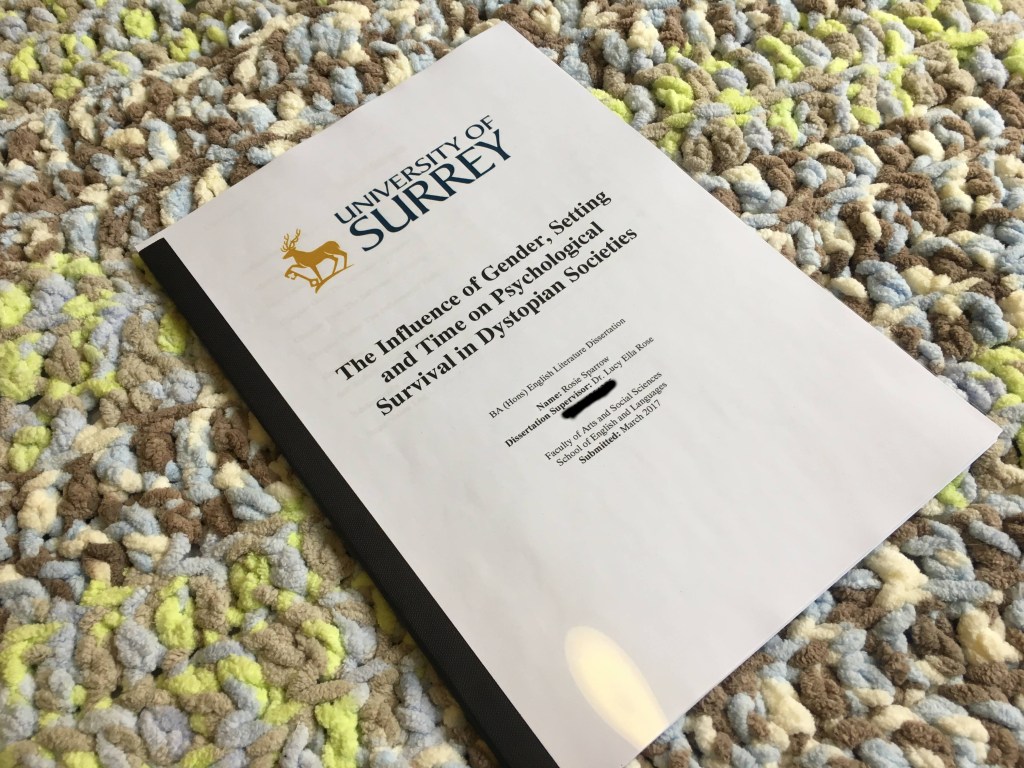
Final, bound, draft of my dissertation.
Finding a work space
Before my placement year I would do all of my work at my desk in my room. It was just comfortable and quiet, although I can’t say that I was the most productive all the time because of it! As I’d been working in London I got used to doing a ‘9-5’ as it were. So, I thought it would be best to try a similar approach when it came to my dissertation.
At first I did think about going to the library, which had a lot of different places where you could work either in quiet or total silence. However, it was always busy and you could spend ages looking for the right spot to work, only to find you’ve wasted quite a bit of time.
So, instead, I decided to use my department’s common room. The room was barely used outside of small networking events and presentations, so it was the perfect place to go. It was quiet as not many people would be in there (there were many times when I was the only one) and if you had friends with you, you could quietly chat every now and then without people getting too annoyed with you.
Setting up a routine to get me out of the house and into a different working location really helped me be productive when it came to writing and editing. There was also the odd occasion where I got free food too, which is always a bonus!
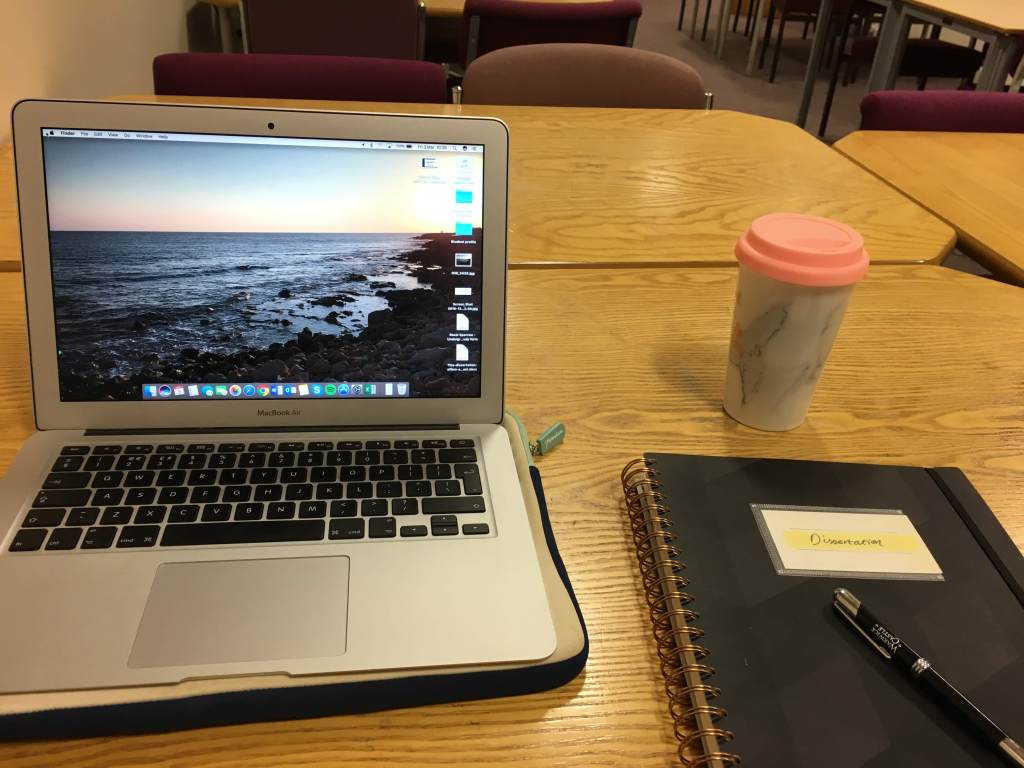
My favourite spot in the common room.
Organising my research
Research is probably the most important part of the dissertation process, if you don’t do enough research or if you don’t do good research then you will struggle when it comes to actually writing your dissertation. Now, when it comes to research, I split my focus into three main sections:
Quotes from the book and analysis
Supporting and conflicting arguments from critics/journals
Quotes from theorists
In my Introduction to Dissertation lecture, we were all told of the importance of properly organising our notes and ensuring that it was all done in a way that made sense to us. Now, I did a placement year before my final year of university and during that time I discovered that I loved spreadsheets.
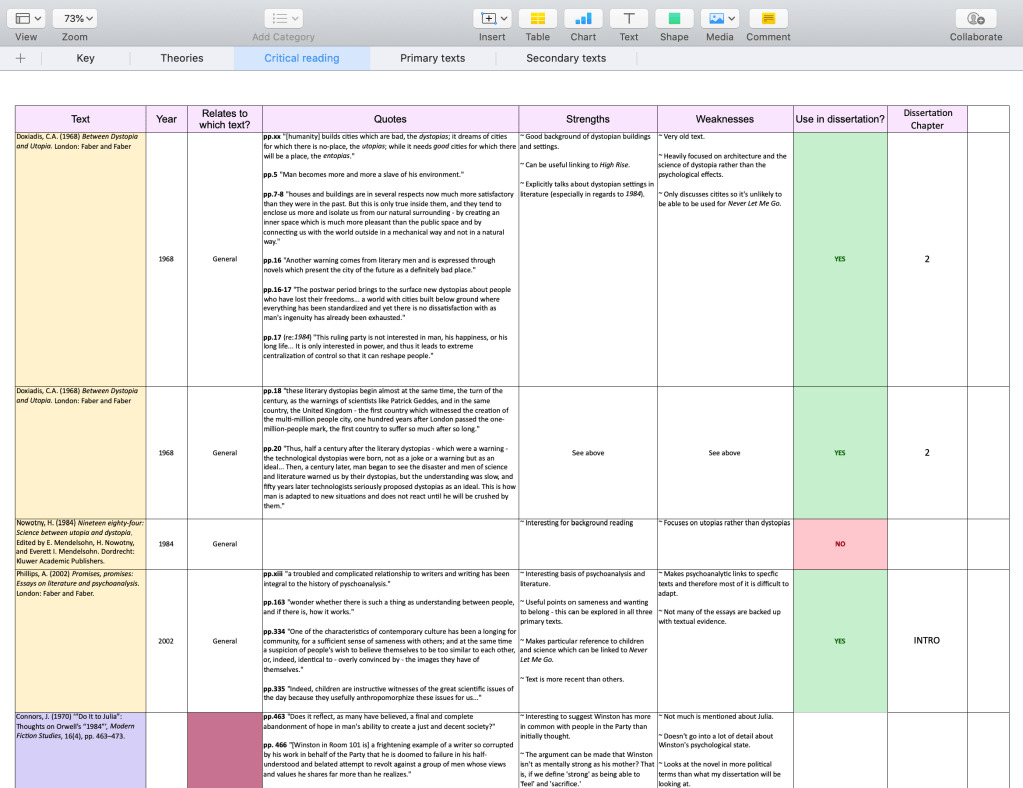
So, that’s what I did. I compiled all of my research onto a hefty spreadsheet. I separated each of the three areas onto a different sheet and then had columns identifying what book the quote related to; what theme it was related to; any comments or analysis I had; the strength and weaknesses of the theory or critic and what chapter of my dissertation it would be best in.
By doing it on a spreadsheet I was able to easily filter all of the information I wanted on a particular text or theme, which was really useful for when it came to actually writing the dissertation. I wouldn’t have to spend ages flicking through notes until I found what I was looking for.
And, of course, it was all colour coded.
A screenshot of my hefty dissertation research spreadsheet!
Drafting the dissertation
My first draft, for any chapter, would always be incredibly rough. I always find the actual writing process difficult to begin, and it’s always much easier to edit than write. I also find it much easier to write things with pen and paper when I’m trying to organise my thoughts. So, in order to make this work for me, I had a thick A4 notebook with dividers where I would write my first drafts.
Now, when I say first drafts, I mean the very bare bones of a draft. It would mainly be my own ideas with random “[use x reference here]” or “[full analysis of x book quote looking at x theme]”. This way I found that my writing, and my thoughts, weren’t interrupted to look for the quote that I was looking for as I knew I could always come back to it later.
When it came to typing up my scrawlings, I would edit as I went along and add in all of the bits that I skipped over whilst handwriting it. For me, this made the writing process far less daunting as it was broken up into chunks. In the end I lost track of the amount of drafts per chapter that I had written and edited.
One of the biggest fears of all university students is losing all of their dissertation through some kind of technical error. As great as technology is, sometimes errors do occur or it fails us (although, this is not common). In an attempt to combat this I wrote each chapter on a separate word document, saved those documents to google drive, emailed them to myself (and to my parents) and saved them on an external hard drive. You may think this is going overboard but trust me, you can never have too many copies of your dissertation in safe places!
Self-Reflection
Now, as part of your dissertation you may need to write a self-reflection in order to explain how your dissertation and research developed. If you do need to do this then it’s important not to save all of it until the end. Of course, you can’t write this until you have completely finished (or mostly finished) your dissertation but it is important you maintain awareness of this aspect throughout the dissertation process.
What was recommended to us, which I found extremely helpful, and also a great way to organise my thoughts better, was to keep a dissertation journal. It didn’t have to be anything formal but the idea was that whenever you were forming a new idea or argument, or found that your research was taking you in a different direction or you just wanted to express difficulties you were having or something you felt proud of. Having a journal as something to refer back to really helps by the time you come to start writing your self-reflection, as too much would have happened to remember!
Remember to have fun!
Okay, so I know I sound like I’m repeating myself from my last university post but this is important. Yes, your dissertation is important and it may feel overwhelming when you first undertake this. But your dissertation is your chance to research books and a topic that you’re passionate about!
This went on for way longer than I expected it to, so if you made it to the very end I really appreciate it! I hope this was helpful and, if you’re undertaking your dissertation this year – good luck!
Do you have any tips to add to this list? Let me know in the comments!
In the medieval town of Hagen, there stands the most famous bakery in all of Germany: Heckler Delights. When the reclusive beekeeper Anika Everhart becomes the first person ever to challenge the bakery, shocking the town with an extraordinary new recipe, she is arrested for suspicions of witchcraft. Hans Heckler, the wicked heir to Heckler Delights, has claimed that Anika is a servant of the devil. If she cannot overcome his scheme and prove her innocence, she will lose more than a mere recipe. She will lose her life.













 Little Bird Book Blog